News & Insights
Inside an 8,000 m² Arcade Machine Factory: One-Stop FEC Supply (2026)
Inside an 8,000 m² factory with about 80 staff and 500+ machine models: the stages a one-stop FEC supplier runs from market research to opening day, and what to check at each one.
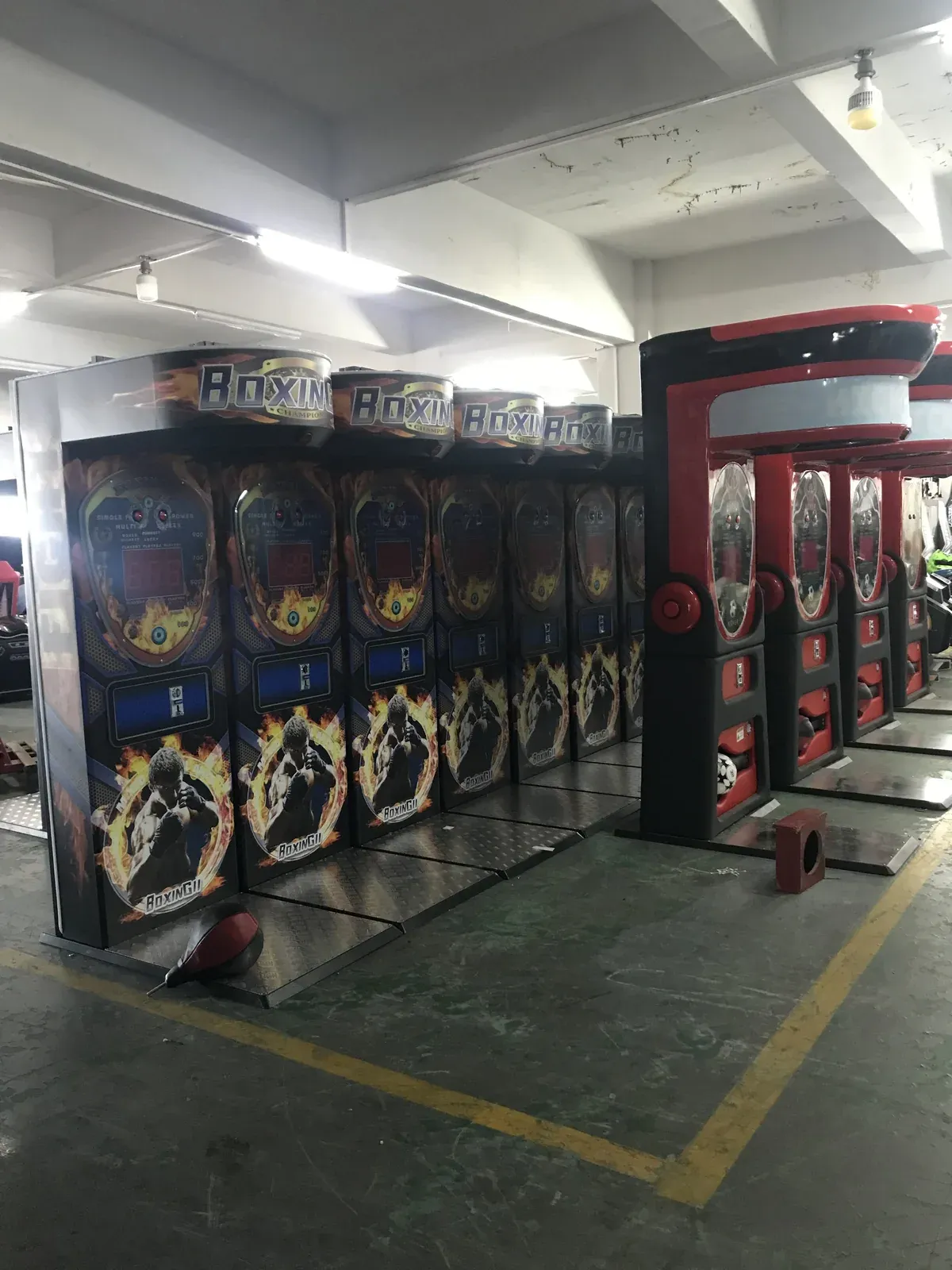
QUICK ANSWER: A one-stop arcade machine supplier should be accountable for the whole project, not just the invoice: market research, layout and 3D design, production, certification, container loading, door-to-door delivery, installation, staff training and after-sales. Ours runs from an 8,000 m² factory in Panyu, Guangzhou, with about 80 people and more than 500 machine models. This is what each stage actually involves — and what to check before you trust any supplier's version of it.
Why "One-Stop" Is the Most Overused Phrase in This Industry
Every arcade game machine manufacturer's website says one-stop. In practice, the phrase often covers a catalog, a price list and a freight forwarder's phone number.
That is not a knock on catalogs. It is a warning about where projects break. An FEC opening has at least six handover points where responsibility can quietly change hands: the design file to the factory, the factory to the quality team, the finished machines to the forwarder, the container to the customs broker, the delivered crates to the installer, and the installed floor to whoever answers the phone when a machine fails on a Saturday night. Each handover is a place where a delay or a defect can become "not our part".
A real one-stop supplier keeps those handovers inside one company. That is the only structural advantage the phrase should promise: one team, one schedule, one point of accountability from the first floor plan to the first repair.
The rest of this article walks through that chain in the order a project actually moves — using our own factory and process as the example, so you can compare it with any quote you are holding.
What an 8,000 m² Factory With 80 People Actually Means
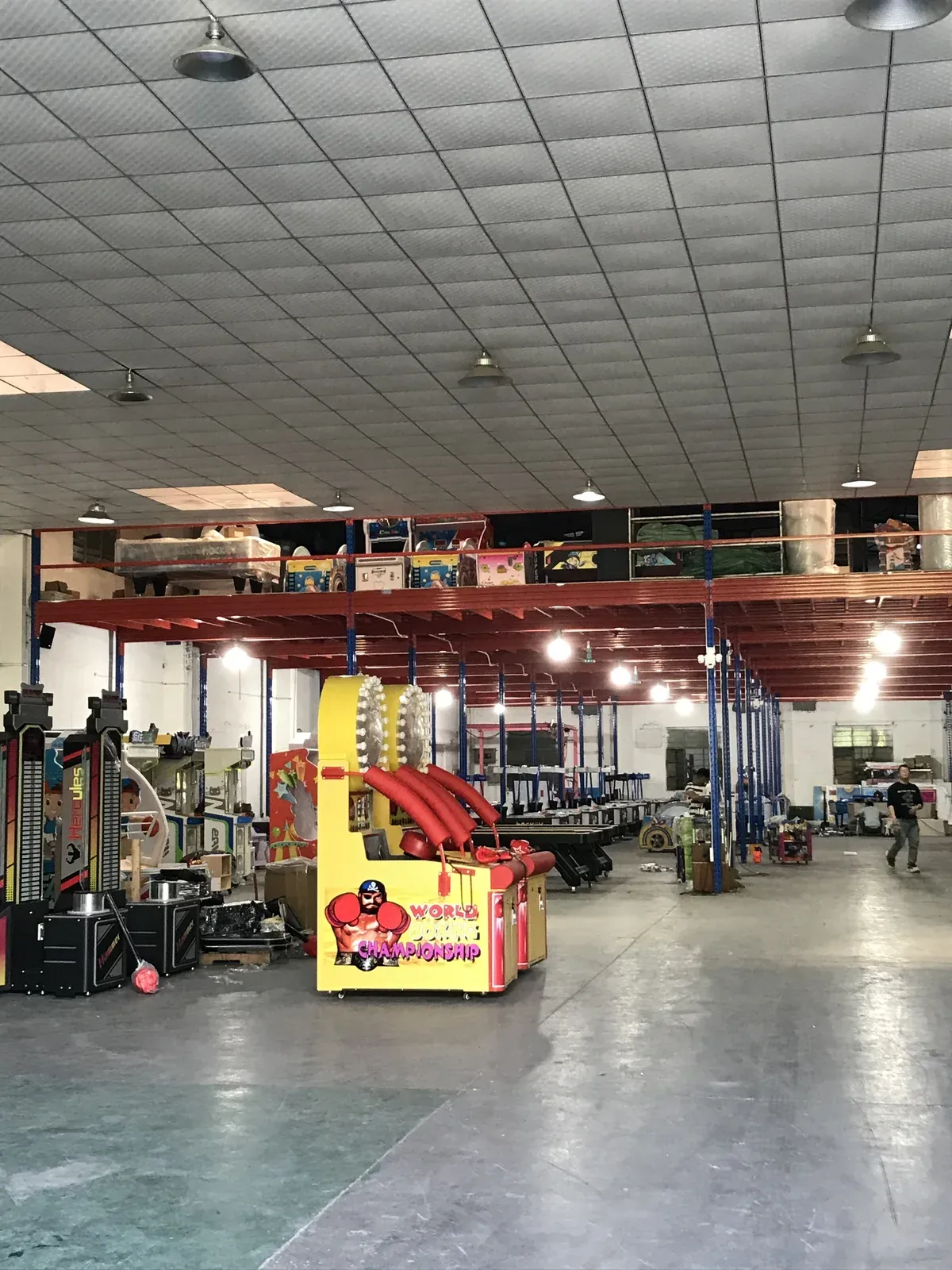
Factory size is easy to inflate on a website and hard to fake in person. Here are our numbers, so you can hold them against what you see on a video tour.
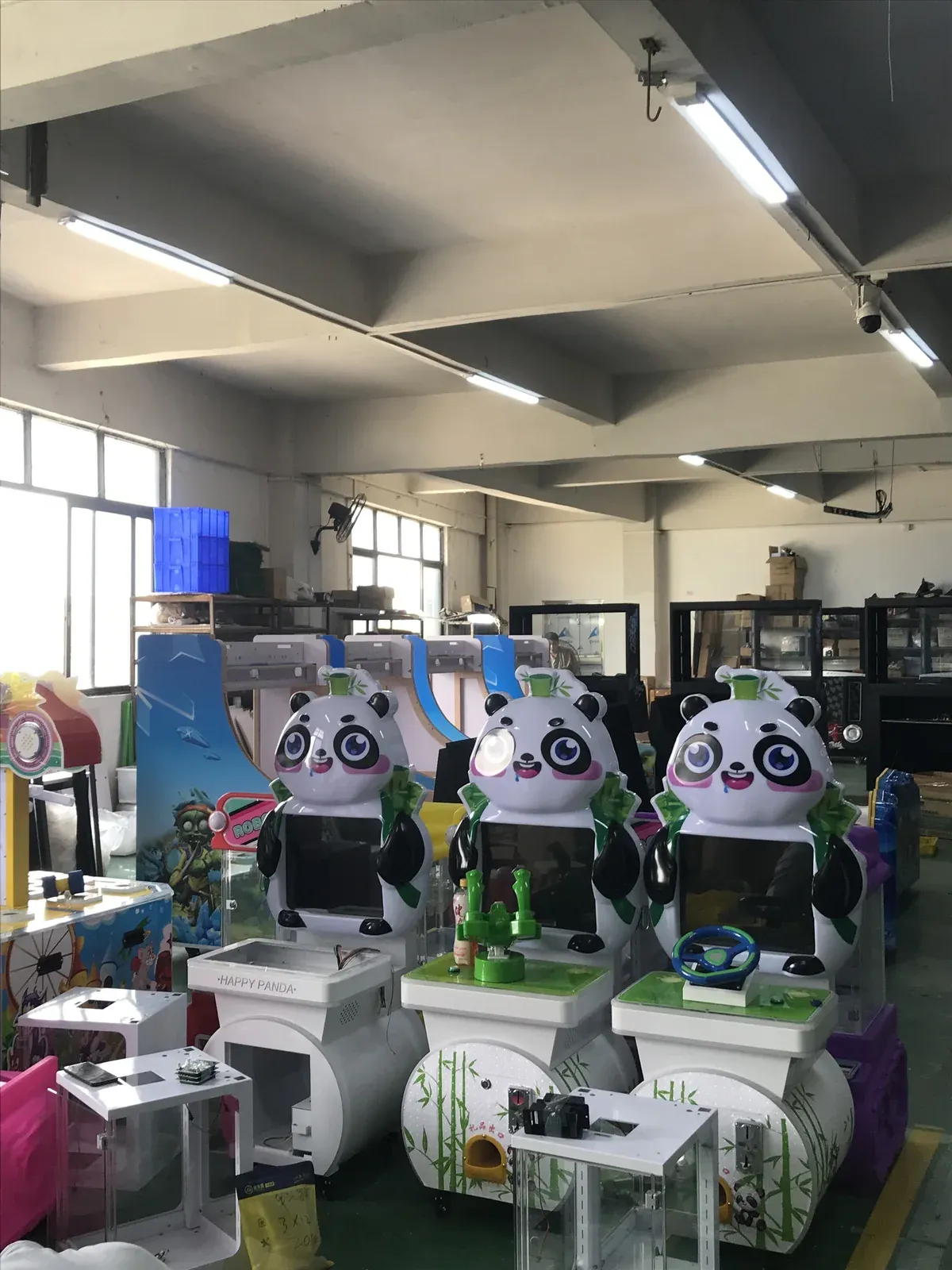
8,000 m² of production and staging space in Panyu, Guangzhou — the district that grew up around amusement equipment manufacturing. That space has to hold assembly bays, wiring and electronics benches, a testing area and finished machines waiting for containers. A trading company with a showroom does not need any of that.
About 80 people on the payroll. The number matters less than what those people are doing: a supplier that lists 500 models with a two-person quality team is inspecting samples, not machines.
More than 500 machine models across claw machines, arcade cabinets, sports and redemption games, kids' rides and VR simulators. A broad catalog is useful at the research stage — you can compare a claw machine, a basketball machine and a boxing machine on the same floor plan — but it is only useful if the same team can also tell you which of the 500 fits your room, your budget and your customer.
That last point is where most sourcing conversations go wrong. A catalog answers "what can you sell me". A one-stop supplier has to answer "what should I buy, in what order, and what will it earn". Those are different jobs, and the second one starts before any machine is chosen.
Stage 1: Market Research Before the Machine List
The first deliverable in a serious project is not a quotation. It is a short set of answers about the venue:
Floor area and ceiling height. Including columns, load limits and the power supply available.
Catchment. Who walks past, how often, and what they are already spending money on nearby.
Competition. What machines the closest venues run, what they charge per play, and which of their machines look busy.
Audience mix. Families with young children, teenagers, young adults, or a mix that changes by time of day.
Budget and opening date. Stated as a range rather than a wish.
Those answers decide the mix. A 200 m² claw machine shop and a 4,900 m² two-floor FEC can both be profitable, but they need different machines, different densities and different staffing. If a supplier quotes you before asking these questions, they are selling you inventory, not a project.
We also use this stage to talk about the opening budget honestly. Machine cost is only one line: shipping, duties, installation, staffing, signage, prize stock and working capital all compete for the same money. If you are still building that number, our breakdown of what it costs to open a small arcade room is a useful starting point.
Stage 2: Layout and 3D Design
Once the mix is agreed, the project moves to drawings. Layout work is not decoration. It decides how many machines fit, how players move between them, where the prize counter sits, how staff can see the floor, and whether the power load can be distributed without a costly upgrade.
A proper design package includes a scaled floor plan, a machine list with dimensions and power requirements, and a 3D view of the main zones so you can approve the look before anything is manufactured. For a multi-zone venue, the layout also has to answer harder questions — where the claw machines sit relative to the ticket redemption counter, how the kids' zone is separated from the racing simulators, and how a visitor is pulled from the entrance to the back of the room.
Stage 3: Production, Not Reselling
This is where a factory and a trading company visibly diverge. It is also the difference between a claw machine manufacturer and a reseller: one builds the machine, the other forwards a catalog. In our production flow, a machine moves through assembly, wiring, electronics, firmware and settings, testing, cleaning and packing.
Two details are worth asking about in any factory tour.
Who makes the control board. We develop our control boards in-house rather than buying a generic board from a third-party supplier. That matters after the sale as much as during production: the firmware that sets claw strength and win cycles is ours, so settings behave consistently across a batch, and a replacement board comes from the same source as the original.
Who tests the machine. A test play is not a formality. It verifies the claw, the coin acceptor, the display, the lighting, the sound and the payout cycle before the cabinet is wrapped. Ask for a test-play video of the exact model you are buying, not a stock video of a similar one.
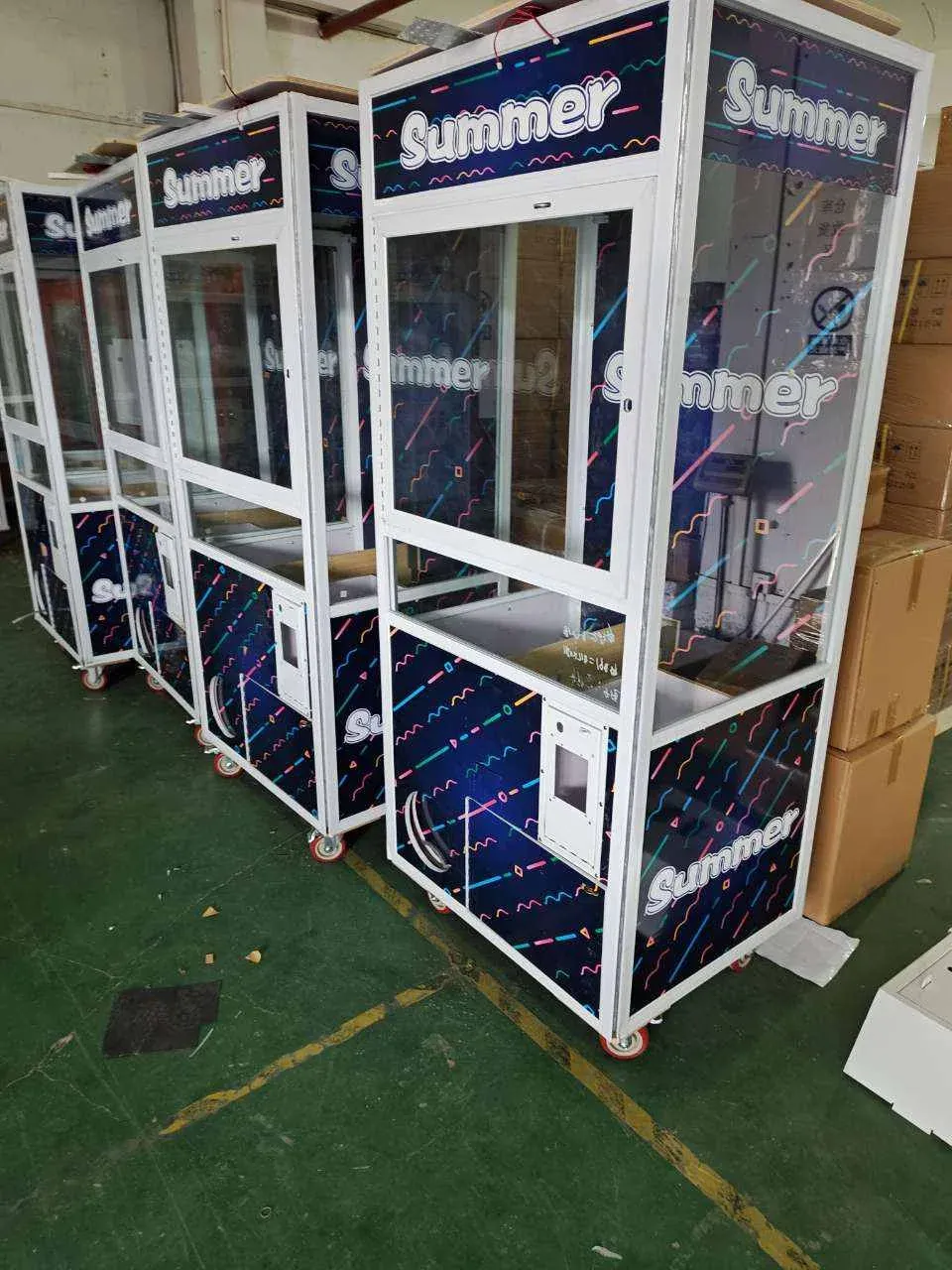
A third detail belongs to the buying conversation rather than the tour: whether the supplier can show you a commercial claw machine built for your venue type — a mall bank, a claw-only shop, or a family entertainment centre — instead of one generic cabinet sold to everyone.
Stage 4: Quality Control Before Anything Is Wrapped
Quality control in an arcade factory is mostly about the parts you cannot see: the thickness of the cabinet board, the gauge of the wiring, the quality of the coin acceptor, the brand of the motor, and whether the harness is labelled so a technician can trace a fault in two minutes instead of twenty.
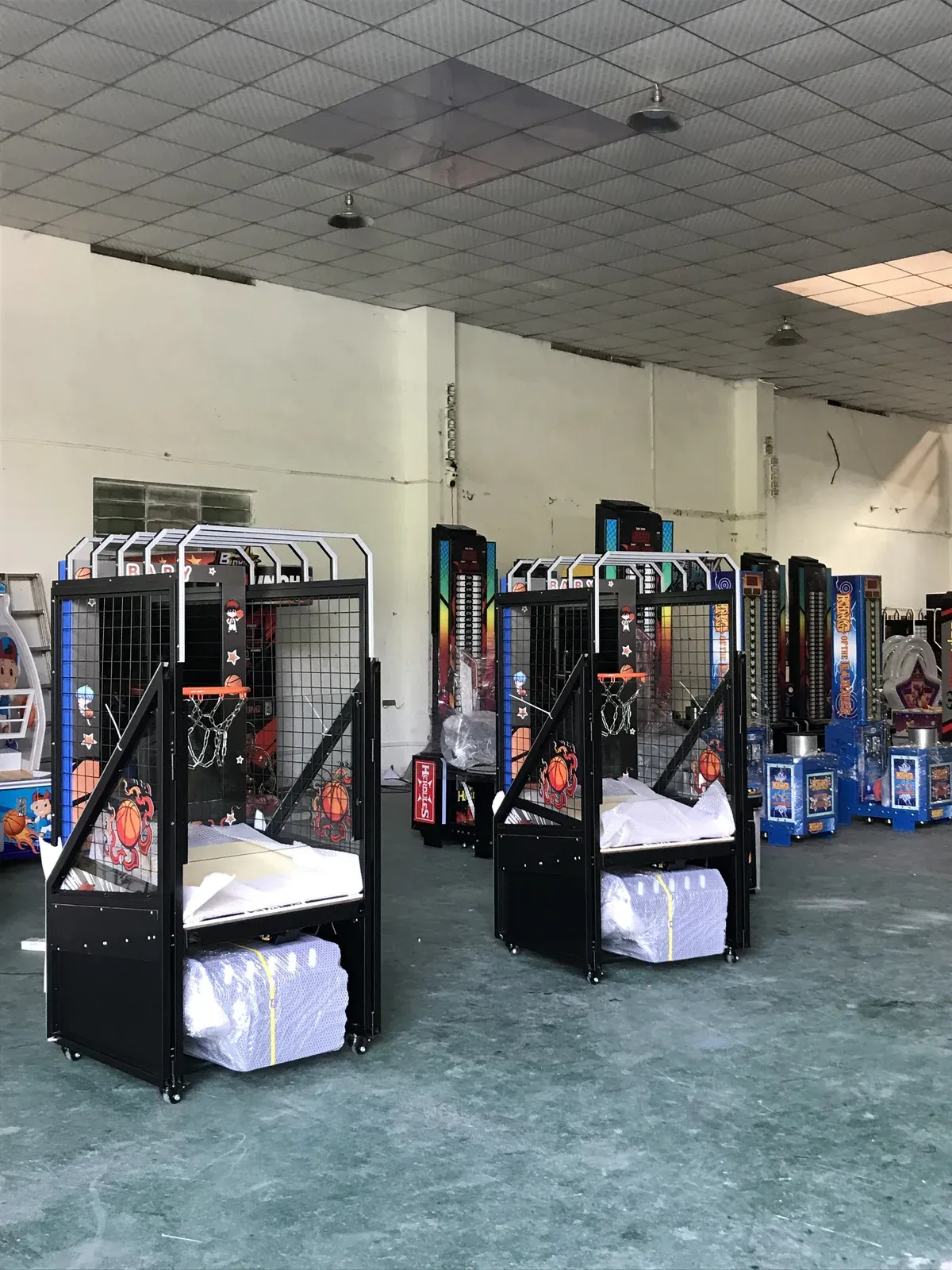
Our process puts an inspection gate before packing: components and workmanship are checked, machines are tested under power, and the packing itself is inspected. That last step is easy to skip and expensive to skip — a machine that arrives with a cracked cabinet or a loose monitor costs more in replacement and downtime than the packing materials ever would.
Stage 5: Certification for the Market You Are Selling Into
Certification is one of the first things a serious buyer asks about and one of the easiest things for a supplier to be vague about. Our CE, FCC and ISO certificates are issued against coin operating machines, and KC covers our LED interactive floor game specifically — but the useful question is not "do you have certificates", it is "what does the certificate actually name, and which market is it valid for". The four labels cover different things:
CE is the European Union's conformity mark, required to place the machine on the market in the European Economic Area — relevant for Spain, France and any EU destination. FCC covers the United States' electromagnetic interference rules; it has no standing in Canada, which runs its own regime. KC is Korea's certification scheme, and on our side it covers the LED interactive floor game, not the full range. ISO is a quality-management system standard rather than a product mark — it says something about how a factory documents and controls its processes, not about a specific cabinet.
Practical buyers should also check the electrical side: machines for the US and Canada are built for 110–120V, while Spain, France, the UK and most of Southeast Asia run 220–240V. A supplier that treats voltage as an afterthought is a supplier that has not shipped much.
Stage 6: Container Loading and Door-to-Door Delivery
Freight is where the cheapest quote often stops being cheap. Two containers loaded badly can cost more in damaged cabinets and wasted volume than the difference between a good forwarder and a bad one.
Our loading process uses a computer-calculated container plan, supervised loading, and packing planned around each machine's dimensions. The goal is simple: no wasted cubic metres, no machines crushed against the container wall, and a load that matches the packing list.
On the paperwork side, we prepare the customs declaration documents for the shipment and quote door-to-door delivery. For a first-time importer, door-to-door is usually worth the premium: one invoice, one schedule, and one team accountable for the last mile.
Stage 7: Installation, Training and Opening
Installation is the stage most likely to be underestimated by a first-time buyer. A container of assembled machines is not plug-and-play: cabinets need to be positioned, levelled, wired to the venue's power distribution, connected where linked play is used, and tested under the venue's own network and payment setup.
We can send technicians to site to assemble and test the machines, train your staff on operation and settings, and help plan the opening schedule. Staff training is not a courtesy — it is what stops a floor from depending on one person who knows how to clear a coin jam.
The scale this can reach is best shown by a real project: a two-floor, roughly 4,900 m² FEC in Myanmar that we took from design to opening in about eight months, with a mix that included children's soft play, kids' go-karts, an arcade, live-action CS, an LED interactive floor and a high-rope course. Different rooms, different power requirements, one project team.
Stage 8: After-Sales, Where the Second Order Is Won or Lost
A machine will eventually stop working. What happens in the first two hours after that decides whether you buy from the same supplier again.
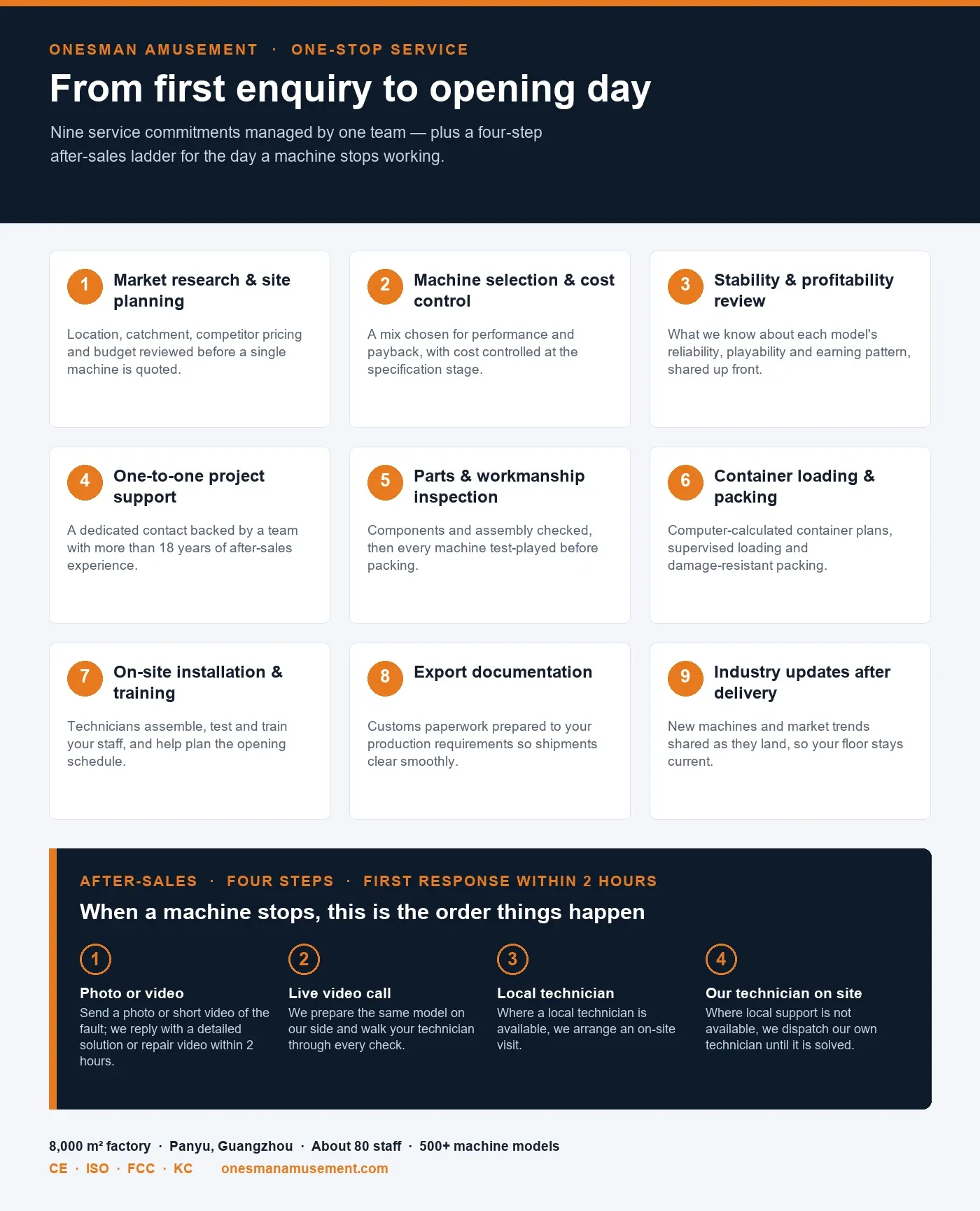
Our after-sales ladder has four steps:
1. Photo or video, then a solution within two hours. The customer sends a photo or short video of the problem. We reply with a detailed solution or a repair video, usually within two hours.
2. A live video call on the actual machine. If the written answer is not enough, we open a video call, prepare the same machine model on our side, and walk your technician through the checks step by step.
3. A local technician, where one is available. For markets where we have a local technician, we can arrange an on-site visit.
4. Our own technician dispatched to your site. Where local support is not available, we send our technician until the problem is solved.
That ladder sits behind a simple commercial promise: a one-year warranty, lifetime free maintenance, and a complimentary spare-parts package with each order. Our after-sales team has more than 18 years of experience, which is the part of a supplier's resume that only shows up after the invoice is paid.
Where Our Machines Go
Our machines ship to the United States, Canada, Spain, Mexico, France, the United Kingdom, Thailand, Myanmar, the Philippines and Indonesia. That list is not a trophy cabinet; it changes how a project is built.
A US or Canadian order needs 110–120V machines, and a US order also needs electronics that meet FCC rules. Both need a freight plan that accounts for the destination port and inland delivery. A Spanish or French order needs CE conformity and 220–240V. Southeast Asian markets bring different plug standards, different humidity and, in some cases, different import documentation. A supplier that has actually shipped to those markets has already made the mistakes somewhere else.
One example we can point to: Clawtopia, a claw machine chain in the United States, opened a store at 8023 W Broad St, Henrico, Virginia 23294 with a mix of claw machines, four-player mini claw machines, scissor machines, a coin changer and a cotton candy machine. The opening settings they used were US$10 for 45 coins, two coins per play, and a prize roughly every five to eight plays.
OEM/ODM: 500+ Models and Still Custom
A catalog of more than 500 models covers most venue types, but it will not cover every brand. Our About page describes two customization routes.
OEM: your brand on a proven cabinet. Custom branding is applied to an existing machine platform, so the cabinet stays proven while the branding is yours.
ODM: a machine developed around your requirement. When the requirement is a new machine rather than a branded version of an existing one, the project starts from a written specification and a target budget instead of a catalog page.
Both routes need the same discipline as a standard order: the requirement agreed in writing, and the same inspection gate before packing.
How to Vet Any One-Stop Supplier
If you are comparing suppliers, these checks separate a real one-stop operation from a reseller with good marketing:
1. Ask for a live video tour, not a photo gallery. Have them walk from the assembly floor to the test area to the packing area in one continuous call.
2. Ask who makes the control board. "We buy it from a supplier" is an acceptable answer; "we do not know" is not.
3. Ask what the certificate actually names. Ask which product category it covers, which market it is valid for, and request the declaration of conformity alongside it — that declaration is what carries the legal weight for CE. For ISO, ask which standard it certifies and request that certificate separately.
4. Ask for a test-play video of your exact model. Watch the claw, the coin acceptor and the display, not just the cabinet.
5. Ask for container loading photos from a past order. A supplier that loads properly photographs it.
6. Ask for the spare-parts list that ships with the order. Consumables and boards should be named, not described as "some free parts".
7. Ask what happens in the first two hours after a breakdown. A written response time is worth more than a friendly promise.
8. Ask for a reference in your market. One customer who has taken delivery in your country tells you more than a page of logos.
Your Next Step
Send us your floor plan, your budget range, your opening date and the market you are selling into. We will reply with a recommended machine mix, a layout direction and an indicative budget.
A factory tour answers questions. A process answers them before you ask.