
News & Insights
Boxing Machine With Prizes: How Payout Changes the Economics (2026)
A strength tester sells a score; a prize boxing machine sells a chance at something the player can hold. How the payout loop works, how to set the threshold, and what wastes the cabinet.
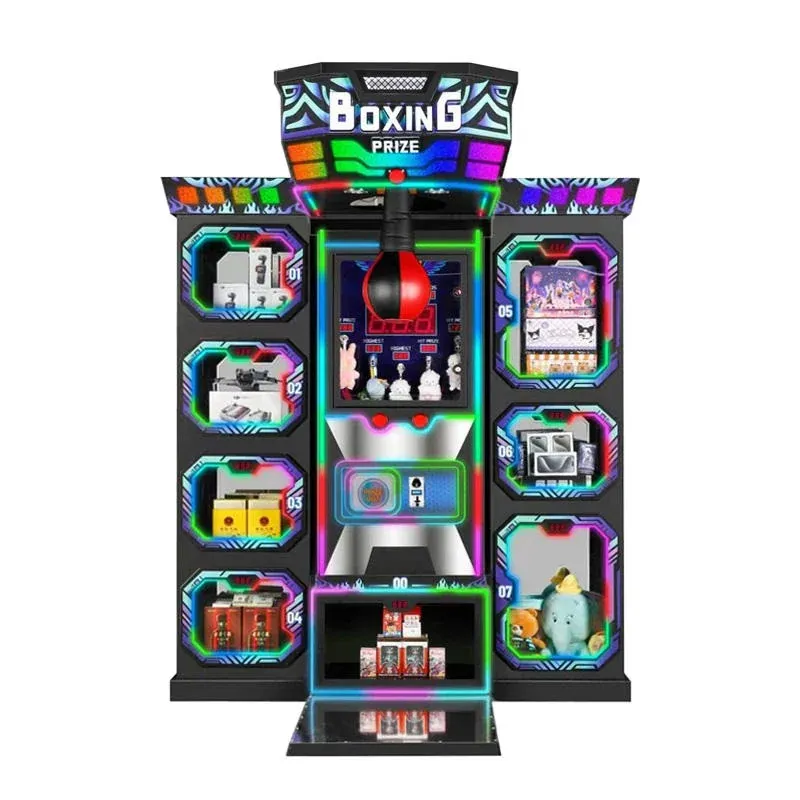
QUICK ANSWER: A traditional strength tester sells a number. A boxing machine with prizes sells a chance at something the player can carry out of the venue. That single change alters who plays, how often they play, and what the cabinet is worth per square metre. This guide covers how the prize loop works, how to set the reward threshold without giving the cabinet away, what prize lines actually fit, and the mistakes that turn a good cabinet into a dead one.
Two Machines, One Cabinet Shell
Walk into almost any arcade and you will find a punching machine. Both are built around the same idea: a bag on a stalk, a display, and a cabinet that takes coins.
The difference is what happens after the punch.
A strength tester shows a score. The player either beats the high score or does not, and the interaction ends there. Its revenue depends on competitive pride and on novelty.
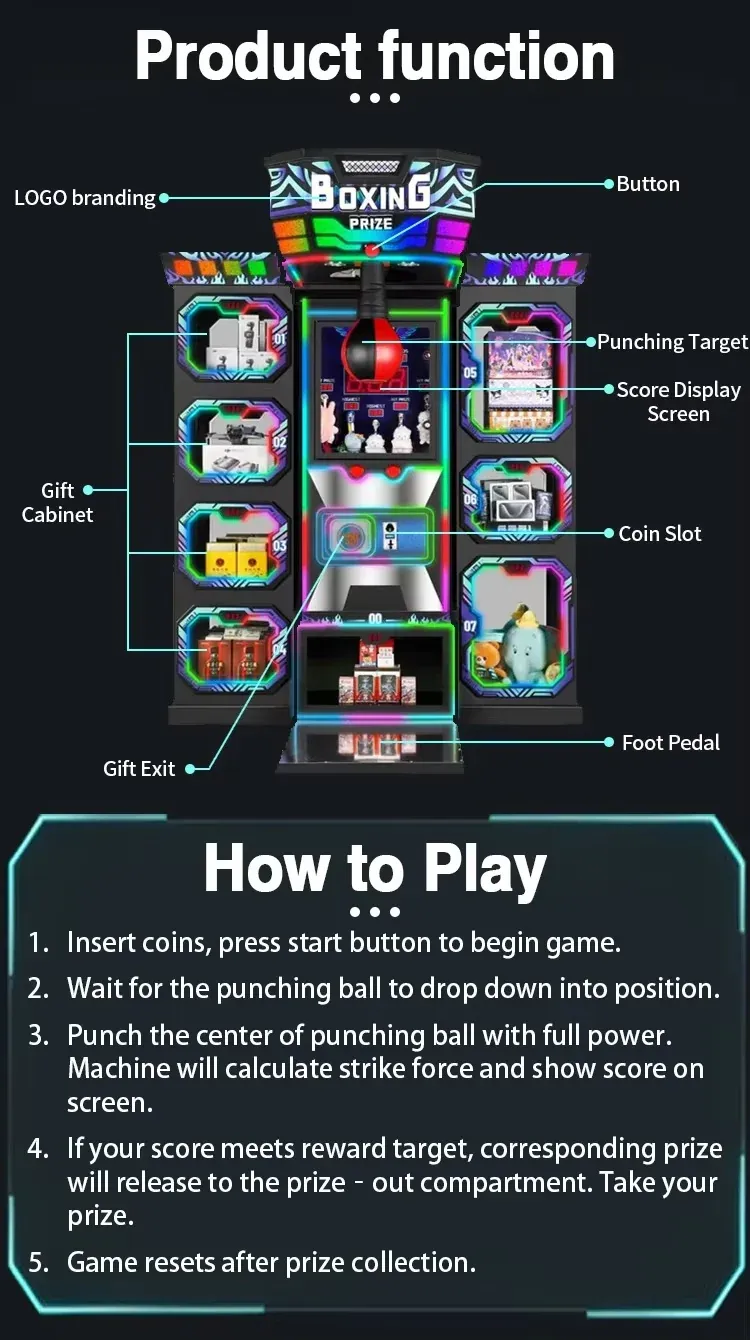
A prize boxing machine shows a score and then, if the score meets a threshold, releases a physical prize. The interaction ends with the player holding something.
That sounds like a small feature. In practice it changes the machine's job. A strength tester has to be discovered; a prize machine can be chosen. A player looking at a cabinet full of plush is not deciding whether to test their strength — they are deciding which prize they want and whether the punch is worth the coins.
If you are still choosing between machine types for a floor, our arcade games for shopping malls guide covers how different machine types are zoned, including where noise-producing machines should and should not sit.
Why the Novelty Curve Matters More Than the Score
Strength testers have an unusually sharp novelty curve. The first week, everyone plays. The second week, the regulars come back to beat their own number. By the fourth week, the machine is furniture unless the floor keeps refreshing its crowd.
A prize changes where the ceiling sits, because the player is not repeating the same experience. They are working toward a rotating catalogue:
The prize changes. Restock the cabinet with a new plush line, a new blind-box series or a seasonal item and the machine has a new reason to be played — without touching the hardware.
The prize travels. A score is forgotten by the next visitor. A plush is carried around the venue, photographed and shown to friends. That is free signage inside your own floor.
The audience widens. A strength score appeals most to players who think they are strong. A prize appeals to anyone who wants the item — including the players who would never queue for a score but will happily spend the same coins on a chance at a specific character.
The cabinet does not get better. The reason to play it does.
The Two Payout Modes and When to Use Each
A prize boxing machine of this type — such as our boxing prize machine with its seven independent gift cabinets — typically offers two dispensing modes, and the choice decides the whole feel of the cabinet.
Gift cabinet mode. A qualifying score opens a specific gift cabinet, so the player receives the item they were looking at. This is the mode for plush, blind boxes and anything with display value. The prize display becomes the advert, and the win feels earned because the player was chasing a prize they picked out themselves.
Single small gift mode. The cabinet dispenses a single small prize instead — the format that suits candy, keychains and fast repeat play. The cycle is shorter, the prize value is lower, and the cabinet behaves more like a vending machine with a game attached.
There is no universally correct mode. A family venue with a lot of young children usually runs the single small gift mode during the day because the win has to be frequent and cheap. The same cabinet in a competitive young-adult venue at night runs gift cabinet mode, where a bigger prize justifies a longer chase.
The practical point: choose the mode per venue, not per machine order. If you run multiple sites, being able to switch one cabinet between the two formats is worth testing before you standardise on either.
Setting the Reward Threshold Without Giving the Cabinet Away
This is where most operators get it wrong — usually in one direction, then overcorrecting in the other.
The threshold is the score a player must reach for the cabinet to release a prize. Set it too high and nobody wins, players stop playing, and the cabinet looks rigged. Set it too low and every second player wins, the cabinet empties by Saturday, and your prize cost eats the revenue.
Three numbers decide whether the setting is right, and none of them come from the machine:
Prize cost per unit. What one prize in the cabinet actually costs you, delivered.
Revenue per play. Coins per play multiplied by the value of one coin. If your venue runs a token system, this is the token price, not the coin face value.
Target margin per win. How much you want to keep after the prize is paid for.
The arithmetic is the same as any prize machine: divide the prize cost plus your target margin by the revenue per play, and you get the number of plays the machine must return for each prize. Our guide to claw machine payout rate settings walks through that calculation with real opening-week figures, and the logic transfers directly to a boxing cabinet — the dials are different, the maths is not.
What changes on a boxing machine is the shape of the distribution. A claw machine rewards a lucky grip. A strength challenge rewards a physical threshold, which means the win rate depends on your crowd. A venue full of gym-goers will beat a threshold that a family venue never reaches.
That is why the threshold should be set on site, after a week of real scores, not fixed at the factory and forgotten.
What Actually Fits in the Cabinet
Prize selection is not a shopping decision, it is a mechanical one. Three constraints apply.
It has to physically dispense. Every cabinet has an opening and an internal path. If the prize is larger than that opening, the machine cannot deliver it no matter how the score is set. Measure the item before you commit to a prize line.
It has to survive the drop. The prize falls into the prize-out compartment. Glass, brittle plastic and anything with delicate packaging will not survive that fall — and a cracked prize is a complaint, not a win.
It has to be worth chasing. This is the softest constraint and the most important. A prize the player can buy for the same money across the aisle is not a prize, it is a transaction. The cabinet works when the prize is either not available nearby, or visibly better than its cost.
In practice, the prize lines that work are plush, trend-driven collectibles such as blind boxes and collectible figures, and — in single small gift mode — candy, keychains and small toys. Anything carrying a licensed character raises a separate rights question, and prize sourcing from the correct channel sits with the operator rather than the cabinet.
Siting the Cabinet
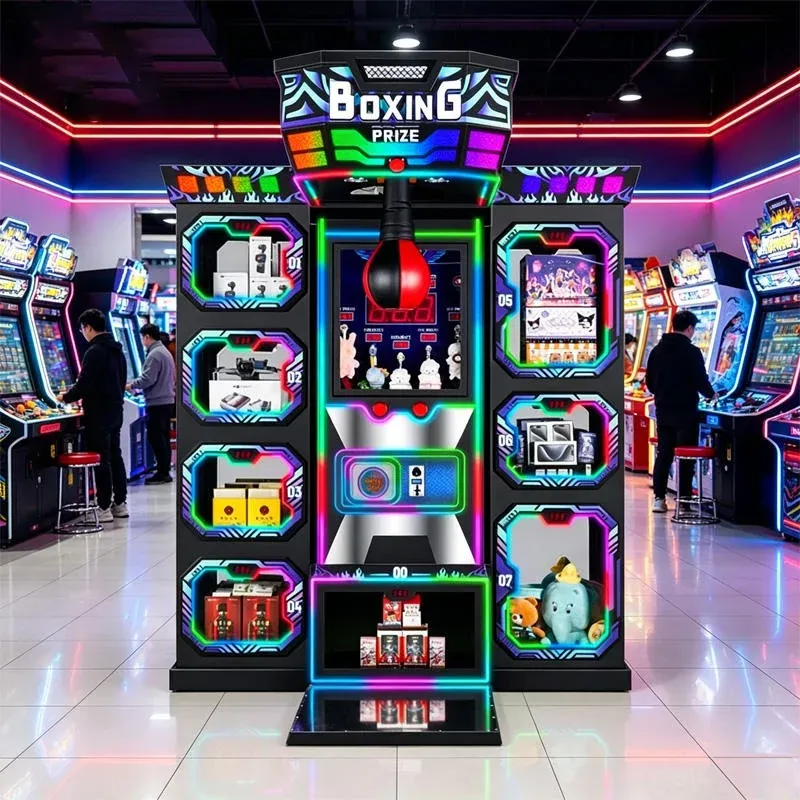
A prize boxing machine is louder and larger than a strength tester, and it earns differently depending on where it stands.
Clear zone in front. The player needs room to step back and punch. A cabinet pressed against a wall or backed onto a walkway gets played once and then avoided.
Sight lines to the prize cabinets. The gifts have to be visible from the main circulation route. If the cabinet is placed so that the prize side faces a wall, you have paid for a display nobody sees.
Not first in line. Counter-intuitively, the best spot is usually just past the entrance rather than at it. Players who have already walked in have committed to the space; a cabinet at the door competes with the doorway itself.
Away from the quiet zones. This is a machine that makes noise, invites a crowd and produces a small audience. That is an asset in an active zone and a problem next to a soft play area at nap time.
Our factory and one-stop guide covers how layout, power and delivery fit together when you are placing several machines rather than one.
Five Ways a Prize Boxing Machine Underperforms
1. Threshold set at the factory and never revisited. A score threshold that suits one crowd is a wall for another. Set it on site.
2. Prize line chosen after the cabinet. A prize that does not fit the opening, or does not survive the drop, converts a working cabinet into a broken one.
3. Prize cabinet treated as storage. The display is the advertisement. A half-empty cabinet with three dusty items tells the player the machine never pays.
4. No rotation. The same prizes for six months means the machine stops being a chase and becomes furniture — the exact failure a prize was supposed to prevent.
5. Payment not matched to the venue. If the venue runs tokens and the cabinet runs coins, or the cabinet cannot take the card system everyone else uses, the machine is awkward to play and staff stop promoting it.
What to Confirm Before You Order
Four answers decide the configuration:
The prize line. Product type, dimensions and weight, because they determine what the cabinet can dispense.
The venue type and crowd. Family, young adult, mixed, or a bar crowd — this decides the mode and the starting threshold.
The payment method. Coin, electronic payment, card or banknote, and whether it has to integrate with an existing token system.
The destination market. Voltage and plug standard, plus the documentation your customs broker will ask for. Certification scope is confirmed per product line and per market rather than assumed from a logo.
Where the Cabinet Earns Its Space
The economics of a prize boxing machine are not complicated, but they are not automatic either. The cabinet provides the loop — punch, score, prize. The operator provides the three decisions that make the loop work: which prizes, which threshold, which crowd.
Get those three right and the machine does something a strength tester cannot: it turns a one-off test of strength into a reason to come back to the same cabinet next week, because next week the prize is different.
A strength tester measures a player. A prize machine gives them a reason to measure themselves again.