News & Insights
Best Arcade Games for Shopping Malls: A Zone-by-Zone FEC Layout Guide (2026)
Which arcade games belong in which zone of a mall or FEC — a zone-by-zone layout guide with real cabinet dimensions, and a 4,900 m² two-floor FEC built in eight months.
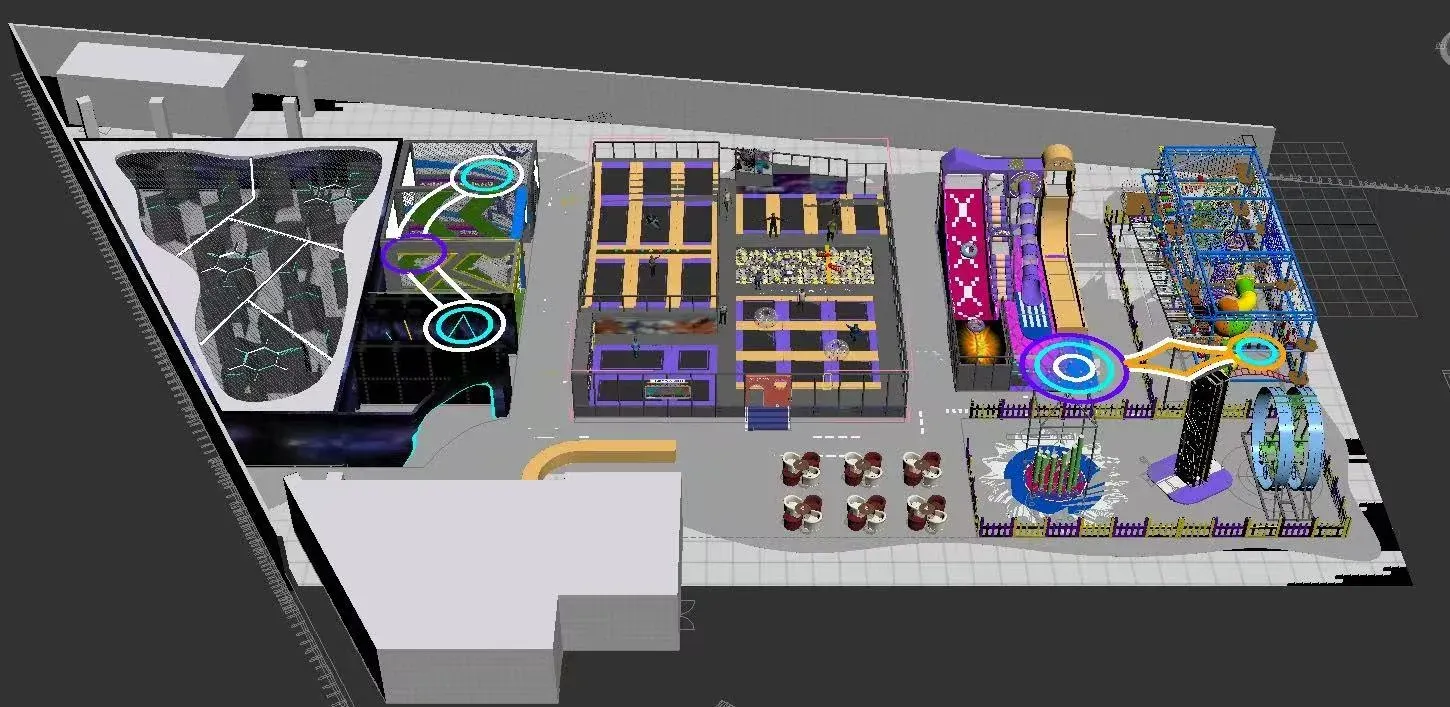
QUICK ANSWER: In a mall arcade or FEC, the machine list matters less than the order you place it in. Entrance: claw machines and prize cabinets that stop the walk-by. Mid-zone: racing and motion simulators that turn a stop into a stay. Family zone: kids machines and redemption games that keep parents in the venue. Exit: the prize counter and coin changer that send people home with a reason to return. In a two-floor venue, destination attractions — laser tag, karting, a rope course — sit deeper inside or upstairs, so they pull visitors through the paying zones on the way. This guide gives the zone rules, the real cabinet dimensions, and a 4,900 m² two-floor FEC built in eight months.
Two arcades open in the same city with the same budget and almost the same machine list. One fills every evening; the other has empty cabinets by month three. The difference is rarely the machines. It is the order they are arranged in — what a shopper sees first, what they can reach, and what their child can play while they decide. This guide is for mall arcade operators, FEC planners and shop owners adding a game corner, and it focuses on one question: which game belongs in which zone, and why.
Why Two Arcades With the Same Machines Earn Different Amounts
Picture the two units side by side. Unit A put its racing simulators near the entrance — impressive machines, but they need commitment, and a shopper walking past does not commit. Unit B put a lit bank of claw machines in the first sightline, with plush prizes visible from the aisle, and kept the racing simulators deeper inside. Same machines, same prices, different order.
The shopper's decision happens before they read a single price tag. In the first seconds, they answer two questions: can I see something I want, and can I play it without effort? The entrance answers both or loses them for the day.
What a Bad Layout Costs You
A bad layout does not show up as a broken machine. It shows up as:
Dead corners. Machines hidden behind a pillar or facing a wall collect dust while the same model near the aisle earns every night.
Wasted walk-by. If your entrance holds storage, a staff desk or empty floor, you are paying mall rent for the one asset that actually creates revenue — attention.
Bottlenecks. A cabinet placed where two families cannot pass each other turns a busy evening into a frustrating one. People leave before they play.
Hidden prizes. Claw machines are a prize-display business. If shoppers cannot see the plush from outside, the machine's strongest advertisement is switched off.
What Mall Shoppers Actually Do
Most mall visitors are not planning to play arcade games. They are in the gap between errands — waiting for someone, resting, or giving a child something to do. That gap is your market.
Three behaviours shape layout:
They scan before they walk in. The first visible cabinets decide whether the venue is "for them" — parents look for kids machines, teenagers look for racing and VR, couples look for claw machines and prizes.
They stop at what they can already see working. A cabinet with someone playing is a demonstration. A row of spectators is social proof.
They leave when the flow feels awkward. A crowded aisle, a queue at the change machine, or a parent who cannot see their child all end the visit early. Good layout removes those reasons before they appear.
The Zone-by-Zone Framework
Four zones, each matched to the shopper's state at that moment:
Entrance — "walking past." Your job: stop them. Instant visual pull, minimal effort, no commitment.
Mid-zone — "already stopped." Your job: give them something worth a longer stay. Immersive machines that need time, and that gather spectators.
Family zone — "with children." Your job: let the child play and the parent relax. Low cabinets, short sessions, a sightline between them.
Exit — "leaving." Your job: the last play and the reason to come back. Prize redemption, the coin changer, and one small surprise.
In a larger venue, one more principle sits above the four zones: the further an attraction is from the entrance, the stronger its pull must be. A claw machine can earn at the front door; a laser tag arena, a kart track or a rope course only work if you give visitors a reason to walk all the way to them — and a route that passes paying attractions on the way.
Zone 1 — The Entrance: Machines That Stop the Walk-By
The entrance has one job: make a passing shopper stop. The best machines for it share three traits — visible prizes, instant understanding, and no learning curve.
Claw machines are the natural entrance machine. The cabinet is a display case: plush toys at eye level, a lit lightbox above, and a prize that falls with a satisfying drop. Nobody needs instructions. A full-size claw cabinet such as our Crazy Toy Machine (800 × 800 × 1900 mm, drawing roughly 60 W) is bright, compact and easy to line up as a bank.
A bank of ten draws roughly 600 W in total — a modest load, which matters when you are planning power for a mall unit.
The entrance is also where a small machine pays off. A Mini Claw Machine around 500 × 300 × 1740 mm — only 30 cm deep — fits a narrow wall or column edge where a full-size cabinet will not go, and it catches the shopper who is already walking past.
What not to put at the entrance: racing simulators and motion games. They are excellent machines, but they ask for commitment before the shopper has made one. Put them where they can gather a crowd instead.
Zone 2 — The Mid-Zone: Machines That Turn a Stop Into a Stay
Once a shopper has stepped inside, the question changes from "is this for me?" to "what should I play?" The mid-zone answers with machines that are worth a longer stay.
Racing simulators are the anchor of the mid-zone. They are large, loud and visual — and they create spectators. A racing cabinet like the Batman arcade simulator takes roughly 110 × 175 × 240 cm, so plan depth first: the player needs room to sit, and the crowd needs room to stand behind them.
Group them. Two to four linked racing units turn a single player into a group activity — the passers-by who stop to watch become the next players. A single cabinet alone in a corner earns once; a row of them earns all evening.
Add motion and VR here, not at the door. Motion simulators and VR need explanation and a longer session; they perform best after the shopper has already decided to stay. Keep the queue area clear — a crowd waiting is good for business, a crowd blocking the aisle is not.
Watch the power plan. Larger cabinets draw more: a 400 W claw or simulator cabinet is not unusual, so map your circuits and distribution before the fit-out, not after.
Zone 3 — The Family Zone: Machines That Let Parents Breathe
The family zone is where the venue earns its reputation. A parent who can sit down, see their child, and let them play for ten minutes will stay — and return.
Choose machines by the child's height and attention span, not by the operator's taste. A whack-a-mole game around 510 × 630 × 1000 mm is reachable, understandable and finished in ninety seconds. Ball-shooting, water-shooting, kids basketball and kids air hockey follow the same rules: low controls, short rounds, visible scoring.
Put seating inside the sightline. A bench that lets a parent watch every cabinet is worth more than another machine in that corner.
Keep the family zone away from the loudest cabinets. Racing and boxing machines have their own energy; placing them beside the kids zone turns the parents' rest into a noise problem. A soft boundary — a low partition, a prize shelf, a change of flooring — separates the zones without closing them.
Zone 4 — The Exit: The Last Play and the First Reason to Return
Most operators treat the exit as empty space. It is the second-best selling position in the venue.
The prize counter is the exit's anchor. It turns won tickets and prizes into a transaction, and it is where the customer's last impression is formed. Put it where the flow ends — not where it blocks the door.
The coin changer belongs here, or at the entrance — never in a corner. Coin play stalls the moment a player runs out of coins. A visible changer keeps the play loop moving and removes the most common reason a session ends early.
Add one small, memorable thing. A cotton candy machine or a prize display near the exit gives families a reason to linger — and something to photograph.
Case: A 4,900 m² Two-Floor FEC in Myanmar
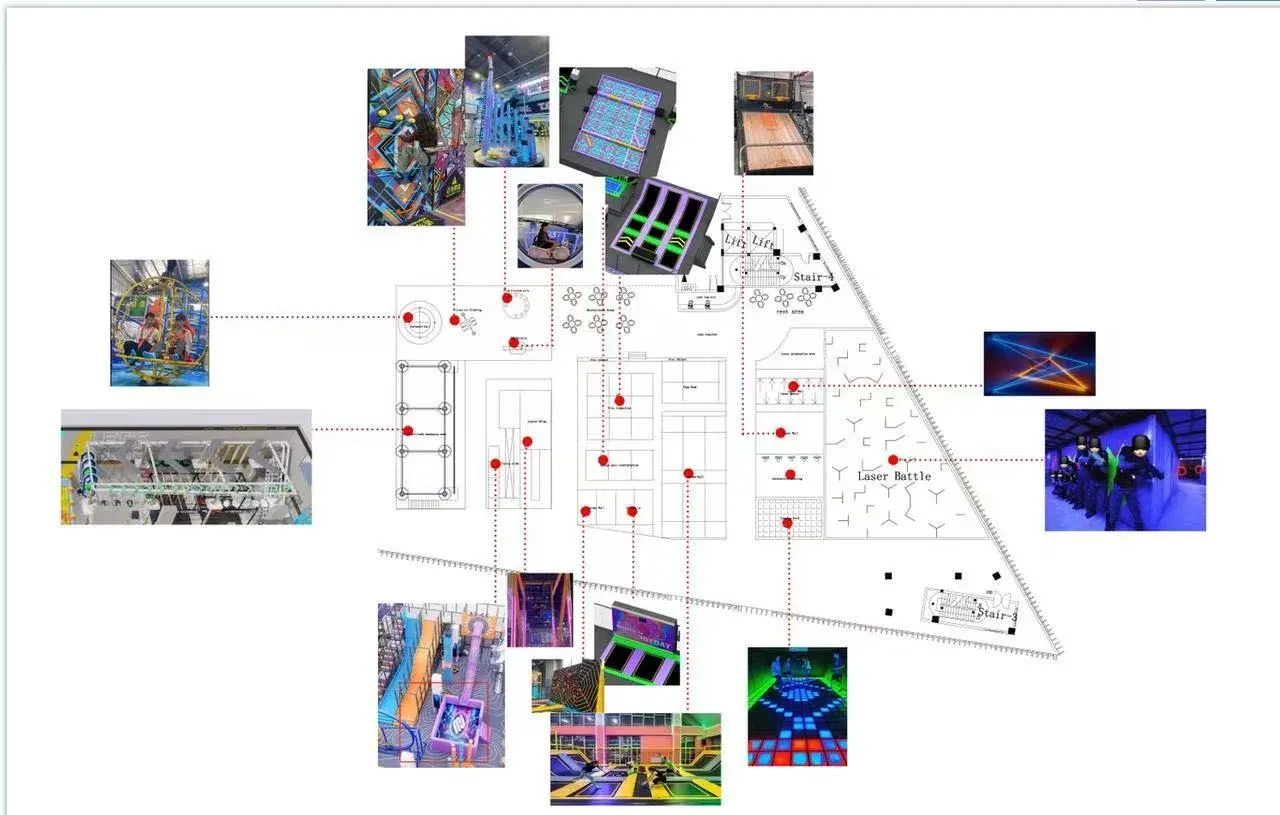
The clearest way to see the framework working is a real project. In early 2026 a family entertainment centre in Myanmar opened to the public: two floors, roughly 4,900 m², a total investment of about RMB 2.5 million (roughly US$350,000) — and eight months from the first design meeting to installation complete.
The attraction list is the interesting part. It was not a single-genre arcade. It covered the full age range in one venue:
- Kids indoor playground (soft play) — the youngest visitors, and the reason parents come at all.
- Kids go-kart track — a physical, high-energy draw for children and a strong photo moment for parents.
- Arcade and prize machines — the classic repeating-revenue floor.
- Live-action CS (laser tag) — a destination attraction for teenagers and groups.
- LED interactive floor — a spectacle area that works as a stage, a photo point and a short-session game.
- High-altitude rope course — the all-ages challenge attraction that gives the venue something no phone can imitate.
What made the mix work was not the list — it was the sequence. Kids play happens early in a family visit and it is parent-supervised, so it sits close to the entrance flow. The arcade and prize floor sits where the traffic passes, converting family footfall into play. The laser tag arena, kart track and rope course are destination attractions: they justify a longer visit, a higher spend and a second floor, and they need the space and ceiling height a mall unit rarely offers on one level.
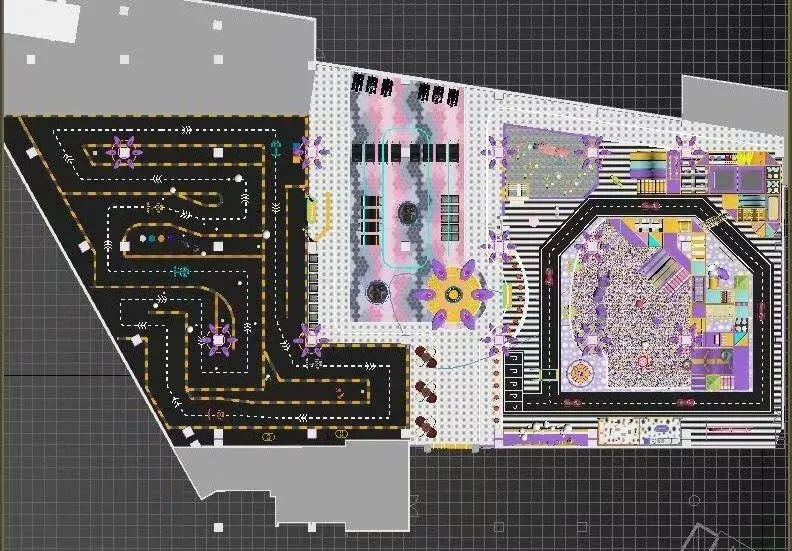
Why eight months matters. A project of this size is not bought off a catalogue. It starts with a floor plan, a capacity estimate and a zoning proposal; moves through 3D design, equipment selection, production and shipping; and ends with installation, testing and staff training. Eight months is what a coordinated design-to-installation process looks like — and it is the number to compare against when a supplier quotes you machines alone.
What this means for a mall unit. You do not need 4,900 m² to use the same logic. The sequence scales down: entrance → mid-zone → family zone → exit on one floor; and it scales up: add destination attractions to pull visitors through more space and more time.
Case: A Street-Front Claw Machine Store
At the small end, the same logic applies. Clawtopia — a claw machine chain in the United States, with its Henrico, Virginia store at 8023 W Broad St, Henrico, VA 23294 — built its floor around different kinds of win moments: standard claw machines for the classic experience, a 4-player mini claw machine so a family can play one cabinet together, scissor machines for skill-based prize cutting, a coin changer that keeps play frictionless, and a cotton candy machine that turns a visit into a small outing.
Notice what is deliberately absent: no attempt to fit every category into a small floor. Each machine type answers one visitor state — the passer-by, the couple, the family, the prize hunter.
The Physical Numbers Your Plan Must Respect
A layout that ignores dimensions is a drawing, not a plan. These are the real cabinet numbers from our current line:
Crazy Toy Machine (full-size claw cabinet): 800 × 800 × 1900 mm, 220 V, 60 W.
Panda Claw Machine (fully transparent): 800 × 900 × 2000 mm, 220 V, 400 W.
Mini Claw Machine: 500 × 300 × 1740 mm, 220 V, 150 W.
Batman racing simulator: about 1100 × 1750 × 2400 mm.
Kids whack-a-mole machine: about 510 × 630 × 1000 mm.
Three checks before you commit to a floor plan:
Ceiling and door clearance. A 2-metre cabinet has to fit through the door and stand under the ceiling — measure both, and measure the service corridor and the lift as well.
Aisle width. Measure the aisle at its narrowest point and compare it with the deepest cabinet plus a player standing in front. If players and passers-by cannot share the space, the layout will fail on busy days.
Power and access. Map outlets against cabinet power draw, and leave room to open coin doors and refill prizes. Our machines use separate locks for the prize door and the coin box — but only if staff can physically reach both.
Five Layout Mistakes That Quietly Kill Revenue
1. Filling the entrance with machines that need commitment. Racing and VR at the door look impressive and convert poorly.
2. Hiding the prize wall. Claw machines sell the prize first; if the plush is not visible from the aisle, the machine is a closed box.
3. Clustering by category instead of by visitor state. A "kids corner" next to a "racing corner" looks tidy on paper and fights itself in reality.
4. No visible change machine. The session ends at the first empty pocket.
5. Designing around the machine list instead of the walk. The floor plan should start from the shopper's path — entrance to exit — and the machines should fill the stops along it.
How to Get a 3D Layout Before You Sign the Lease
The cheapest layout mistake is the one you fix on paper. From our base in Panyu, Guangzhou, our design team works from a floor plan — or even a rough sketch with dimensions — and prepares a 3D layout of the venue before the fit-out starts. The Myanmar project above is exactly that process at full scale: zoning plan first, 3D design second, equipment and installation after.
Send us three things and we will reply with a machine mix for your zones and a layout you can check against the real space: the floor plan or dimensions, the city the venue is in, and the kind of visitors you expect — families, teenagers, or both.
Your Next Step
Send us your floor plan — even a photo of a hand sketch with the door position and aisle widths marked. We will reply with a zone-by-zone machine recommendation for your space, a reference budget for the venue size, and a 3D layout for larger projects.
The right machines in the wrong order earn less than ordinary machines in the right order.